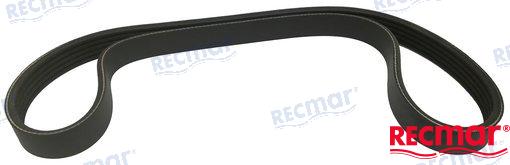
Boat Belts

All commercial and recreational marine engines rely on the transfer of power from one point to another, whether that power is used to propel the boat or to move an auxiliary component such as a water pump, alternator, compressor, or steering assistance pump. In the absence of a timing chain, a rubber timing belt is used to maintain synchronization between the engine's various parts. The boat belts are consumable parts that get worn through time and engine hours, and their lifespan is also dependent on other parts of the engine. Additionally, the replacement of the belt of a boat is a process that is not always easy, and the most common problem is the tight space of the engine compartment. Considering the above, it is highly recommended to keep an onboard kit with some boat belts in hand – not only you will have a spare if something happens but also will keep you out of trouble, in case that belt of your boat snaps in the middle of nowhere.
PoseidonMarine has an extensive stock of boat belts for inboards and sterndrives like Volvo Penta, Yanmar, MerCruiser and OMC. Of course, equally broadened are the choices we offer for outboard engines like Honda, Suzuki, Johnson, Evinrdure, Yamaha, Mercury, Tohatsu, Parsun and Selva. Expect parts like belt tensioners, idler pulleys, yacht belts for the alternator, steering belts, serpantine belts, drive belts and of course timing belts. Our trusted partner Recmar is providing us with a constant flow of stock of more than 300 different belts for all of these applications. When it comes to a more specialized application, we do have choices like SLP belts or OEM brands, like Continental, SKF, GATES, Mitsuboshi, and other established brands. We are here to offer you parts and advice.
Frequently Asked Questions about Belts for Boat Engines:
-
How often should marine engine belts be replaced
Well, each manufacturer has a routine maintenance schedule based on the hours of use, but as a rule of thumb, 500-600 hours or 36-48 months is the period your boat belts should be replaced.
-
Are engine belts hard to replace?
Yes and no. As mentioned before, every boat has a different architecture and engine compartment layout. Sometimes, there is plenty of space and that job is easy, while in other cases, everything is more than compact and the replacement of a single belt may require a lot of labour hours – even the removal of the whole engine.
-
Are yacht engine belts expensive to replace?
In our store, the majority of our quality replacement boat belts cost less than 25€, while some timing belts are in the range of 100€ or less. Again, the final cost of the replacement of the belt of your boat is determined by the labor cost, which is a variable factor affected by the difficulty of the job, your location, and other parameters. In the end of the day, a boat owner must ask himself: “What costs more? A new boat belt or a snapped one?” According to our preventive maintenance strategy, the rule number #1 is follow the instructions of your engine’s workshop manual and the rule number #2 is observe, listen to your engines, check for leaks, abnormal wear. That way, you will always know when your belt of your boat needs replacing.
-
What indicates that your boat belt must be replaced?
A slipping drive belt on a yacht engine might make that awful noise for a variety of reasons, but they all have one thing in common: You need to replace the belt as soon as possible. It’s a sound which will make any petrolhead cringe: the sharp screech of a slipping fan belt. Well, more technically, because marine engines have no fans, it’s a drive belt, and that dreadful noise normally happens at startup (more on that in a moment). When belts do this, they’re sending out an SOS signal that must be addressed. Typical belts on a sailboat’s engine give motive force to circulator pumps, which pump coolant; raw water pumps, which pump saltwater; and alternators. At times, they also might be used for operating a fridge compressor.Inadequate tension is the most frequent cause of that loud screech, but it's not the only one. Another problem known as glazing occurs when a belt slides due to insufficient tension. Heat is rapidly produced when the belt slips, melting and cooling the belt material, which ultimately results in plasticization. To put it another way, the belt gets brittle and hard and frequently cracks. If glazing happens, the harm is already done and retensioning won't fix the problem.But hold on, things get worse. In addition to causing damage to the belt, slippage may also cause damage to the pulley walls, which may also become glazed and resemble highly slippery surfaces like chrome or polished stainless steel. Most boat owners' initial instinct is to replace a defective belt or one that has completely snapped due to slippage. However, if the pulley is also glazed, that will typically result in repeated occurrence. In that scenario, more remediation is necessary; the glazed drive surfaces of the pulley must be reconditioned by sanding them using 220 grit emery paper. This will change the polished surface into one that is satinlike or duller, which will improve the belt's ability to acquire traction.
-
How to fix belt slipping?
Well, it is obvious that the belt must be properly tightened and the pulley not glazed. Do not forget to check the rest of the pulleys for curvature—it is easy to spot; they will revolve slightly eccentric and may create a slight wobbling.
-
Are there any warning signs before a timing belt breaks?
This is the ultimate nightmare of all gearheads: the belt of the belts, the one that can send your valves cuddling with your pistons and ruin your whole boating season. There might be some squelling before this unfortunate event, some rattling or other screeching sound but at the end of the day, a yacht timing belt can snap suddenly. The best way to minimize your chances is to prevent it in the first place.