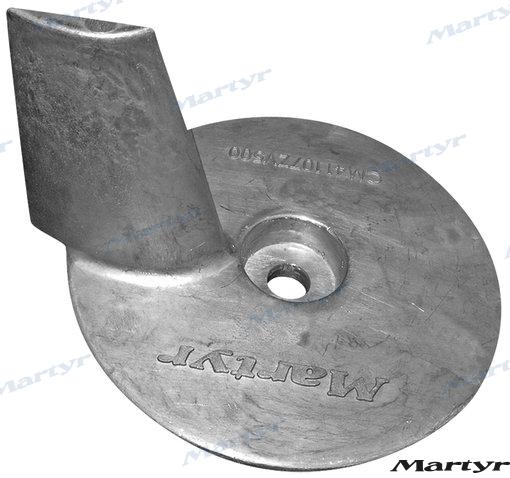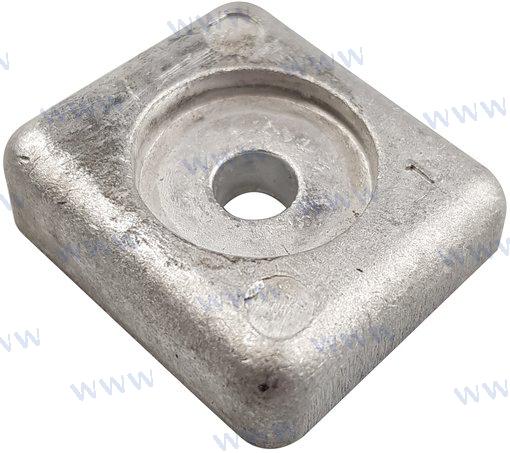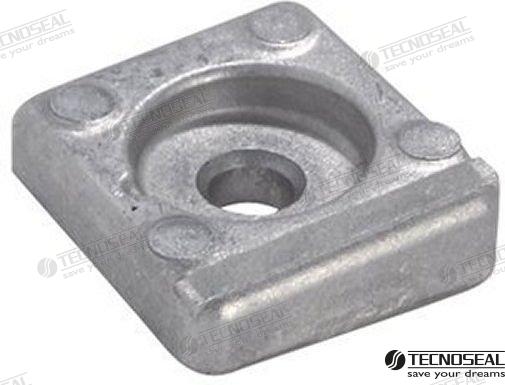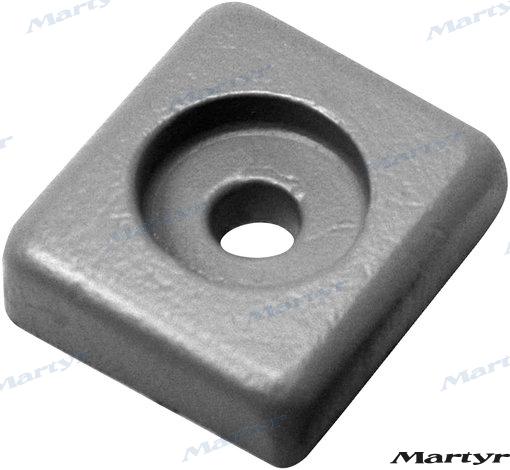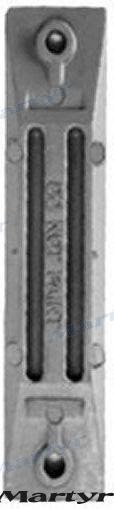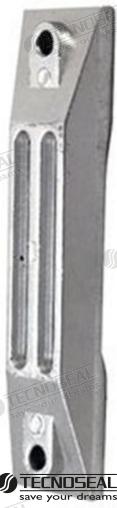
Zinc, Aluminum, and Magnesium anodes for boats (All anodes)

Poseidon Marine will analyze one of the eternal debates in the boating world:
Should I use aluminum or zinc anodes on my boat?
The anodes, which are sometimes called simply zincs, are necessary parts of a marine application to neutralize corrosion and protect the metal parts of your boat, or the hull itself. Since zinc was the first metal to be used as a sacrificial anode, the term “zinc” sometimes replaces the word anode, without that meaning the anode is made of zinc.
If we have to describe the anodes’ functions in a few sentences, and as simply as possible, then we would make the following statement: A cheap-to-manufacture metal will take all the damage (corrosion) to protect your expensive hull, propeller, sterndrive, or other metal element of your expensive boat. During the time your boat’s or yacht’s elements are underwater for extended periods, the galvanic corrosion will damage the nobler metals, which in that case are the anodes.
Zinc, aluminum, and magnesium serve the same role, which is the prevention of corrosion. The choice of each metal will depend on a number of variables, which we will try to analyze in the following paragraphs. We, at Poseidon Marine, are trying to keep a diversified stock of anodes, both in terms of shape and size, and in terms of material. Here are some of our most popular anodes and kits:
- Tecnoseal® Anode Yanmar 1GM 1GM10 engine block Zinc 27210-200200
- Recmar® Zinc Anode for MerCruiser QSD 8M0151541 Yanmar 120650-13420
- Recmar® Anode Plug Volvo Penta 3838500 838928 858754 861546 18-6021
- Recmar® Magnesium Anode kit for Volvo Penta SX DP-SM 3855412 3855610
- Recmar® Aluminium anode Volvo Penta 3838499 800476 804107 838929 858501 18-6001
- Recmar® Aluminum Anode kit for Volvo Penta IPS 3593981 40005875
- Recmar® Zinc Anode kit for Volvo Penta SX-A DPS-A 3888814 3888817
- Recmar® Anode for Volvo Penta Aluminium 130S 150S MS25S 22651246
- Technoseal® TEN00744 zinc anode coupling steering bar DPH DPR VOLVO 3807400
- Recmar® Anode Kit Magnesium for MerCruiser Bravo 3
- Recmar® zinc anode kit for Mercury Verado 4 cyl. 8M0107551
- Recmar® magnesium anode kit for Mercury Verado 6 cyl. 8M0126671
- Tecnoseal® 02528AL Aluminum Anode Washer Hamilton Jet HJ274/292/362 112657
- Tecnoseal® 02527AL Aluminum Anode Hamilton Jet HM461 107890
- Tecnoseal® 02525AL Aluminum Anode conic rod Hamilton Jet HJ274 HJ322 HJ362 111654
- Tecnoseal® 02524AL Aluminum Anode plate Hamilton Jet HJ274/292 HJ322/362 HM422
- Tecnoseal® 02523AL Aluminum Anode disc Hamilton Jet HJ273/274/291 HJ321/322/362/363 HJ402/422
- Tecnoseal® 02521AL Aluminum Anode bar short Hamilton Jet HJ274 HJ322 HJ362 203124
Back to school - short chemistry lesson! How do the anodes work:
The anode is the item that contributes electrons to the circuit. Ok, great, but this is not the time for physics, so let’s make it simpler. Contributes electrons = your expensive outdrive is losing material from its aluminum. Circuit = water.
То call something a circuit, you need more than two metals and a vessel to carry these ions. The vessel is the water, and the two different metals are various parts of your boat (or other boats) that are electrically connected. This will create a certain amount of current flow between the different metals. Long story short, this is a battery. A vivid example of a battery is your aluminum heat-exchanger and your cast-iron elbow. Most boaters with a Volvo Penta D2-55 or an MD20X0 engine know that well. The anode is the heat-exchanger, which is losing ions (gets corroded) due to the electrocurrent created with the exhaust elbow.
The PROS of aluminum anodes:
The aluminum anodes are preferred over zinc by most manufacturers and boaters as well, for a couple of reasons:
-
It is a very good all-arounder. It will protect decently for short periods of time in the freshwater, will do well in brackish water, and will outperform all other metals in saltwater environments. In a less conductive environment, an aluminum anode will get passivated; a layer of black slime (oxide coating) will render the anode inactive. In that case, that layer must be brushed off in order to reactivate the anode.
-
It costs less. For a manufacturer who has to equip many different models of engines, drives, exchangers, etc., the smooth supply of every anode type is a financial burden. Additionally, zinc anodes, being denser, weigh more, which costs more in logistics terms. Over the last 20 years, the mining industry has made the prices of aluminum more affordable, a fact appreciated by the boating manufacturers.
-
In a so-called “environmentally aware” society that measures the gas emissions of cattle, the use of zinc is also an issue of criticism. Truth be told, the impact of zinc anodes in our seas is negligible compared to tankers emptying their ballasts…but “green parts” are more likely to sell.
Considering the above, you should choose an aluminum anode if your usual routes include regular shifts between fresh and saltwater, or if you are in brackish or other less salty water basins.
Compared to the other two metals, aluminum costs less, will endure more time, and behaves better when you change salinity levels.
Another important factor to consider is the temperature of the sea; the Baltic Sea is colder than the Caribbean but has lower salinity. Lower temperature means higher oxygen content in the water, which in turn leads to faster corrosion. On the other hand, the warmer waters around Curaçao will have less oxygen dissolved, and the anode depletion will be slowed down. Checking your anodes more regularly when you are sailing in waters with different chemical compositions or temperatures would be a great idea.
Poseidon Marine is a company that serves people all around the world. Therefore, we try to keep in stock every anode type. Aluminum and zinc for the Mediterranean Sea, magnesium for the Danube!
Magnesium anodes: an one way road in freshwater.
Although you can still use zinc and aluminum anodes in a lake, magnesium will outperform both. The freshwater has higher resistance, and this is where the magnesium’s large current output comes in play. Yes, magnesium anodes cost more, are less dense than the other two, will get consumed faster, but will not get passivated, and will protect your boat actively in freshwater conditions.
Besides the risk of overvoltage, which is observed with hydrogen release due to the high output of this metal, the life of a magnesium anode in saltwater is too short to be considered an option.
Since Poseidon Marine is located in a water crossroads, where the Danube meets the Black Sea, and the nearby countries, like Greece, Croatia, and Italy, are in the Mediterranean Sea, we have customers who navigate all types of waters. Therefore, magnesium anodes and kits are a standard inventory item, ready to be dispatched whenever you need them.
Zinc anodes: there is still use for them.
Zinc anodes do not get passivised, since the chemistry of the metal limits the creation of that slimy coating we mentioned before. Additionally, when that happens, zinc anodes will shed of that film, exposing clean zinc to the water, and maintaining the anode’s electrical activity. For that reason, we suggest using zinc if you plan to dock your boat in seawater for extended periods.
Contrary to zinc anodes, aluminum ones create an oxidized layer that can be removed only with mechanical means; if not removed, the anode is not active.
Long story short, an anode costs pennies compared to your propeller shaft or the housing of your sterndrive. Make a habit of including the inspection and the replacement of your anodes on a regular basis. Poseidon Marine has the knowledge and the experience to guide you towards the proper choice of anodes for your yacht.
5 Useful Tips Concerning the Anodes:
-
An anode needs an electric contact in order to protect. This means it must face a bare metal surface, or it can be grounded on the surface we want to protect, with a wire.
-
When 50% of your anode is gone, it’s time to change it.
-
As said above, the applied surface must be bare. Painting the anode, or the contact area, will render the anode useless.
-
Avoid mixing different anode types. If a specific area is kind of isolated (e.g., a propeller shaft of an inboard), you can make an exception there and use zinc.
The first rule of the anode is PROPER CONTACT. Besides paint, barcodes on the anode, and other obvious factors, make sure the contact area is bright and clear. This tip is so important that we decided to repeat it as much as possible.
Frequently Asked Questions About Boat Motor Anodes:
-
What is the best material for boat anodes?
The best material for boat anodes depends on several factors such as the material you want to protect, the water conditions where your boat is located, and how easy it is to replace the anode. Different environments and metals may require different anode materials for optimal corrosion protection.
-
What's better for an anode, zinc or aluminum?
Generally, aluminum protects better since it is a more noble metal than zinc and has a higher corrosion rate. However, if a boat remains stationary for prolonged periods, zinc may be more effective because aluminum can become passivated over time.
-
Should I use a magnesium or an aluminum anode?
Magnesium anodes are suitable for freshwater use only, while aluminum anodes perform better in brackish and saltwater environments.
-
When should magnesium anodes be used?
Magnesium anodes are the best choice when navigating in freshwater environments such as lakes and rivers because they are highly active and provide strong protection in low-conductivity water.
-
Why use magnesium instead of aluminum?
Magnesium is less noble and more chemically active than aluminum, which makes it ideal for protecting metals such as steel, copper, and bronze in freshwater environments where higher electrochemical activity is required.
-
Do magnesium anodes work in salt water?
Yes, magnesium anodes will work in saltwater, but they will corrode extremely quickly. Because of their high activity and rapid depletion, they are generally not recommended for saltwater environments.
-
Will aluminum anodes work in freshwater?
Aluminum anodes can work in freshwater, but they are not the most effective option. Freshwater has lower conductivity, which can cause aluminum anodes to become passivated and reduce their protective effectiveness.
-
Can I use aluminum anodes in salt water?
Aluminum anodes are generally the best option for saltwater conditions. They provide good corrosion protection and longer service life, especially if the boat is used regularly rather than remaining stationary for long periods.
-
How can I tell if an anode needs replacing?
A sacrificial anode should be replaced when it has lost approximately 50% of its original mass or volume. At that point, its ability to protect surrounding metal components becomes significantly reduced.